Infringement-on-Demand? Amazon Faces Trial Over Print-on-Demand T-Shirts
Brothers Tim and Daniel Whelan, through their company Weekend Warrior Clothing, operate officialusadrinkingteam.com, a website that sells apparel with “designs centered around holidays, American drinking culture, and patriotism, using outlandish and crude humor.” The tees, tanks, sweatshirts and hats include simple illustrations accompanied by slogans like Bad Day to Be a Beer, Down Goes Liver, Make Mullets Great Again, and The Grim Rizzer.
Its motto could (should?) be: Duds for dudes to don for day drinking.
At some point, Tim noticed that pixel-for-pixel copies of some of their designs were showing up on t-shirts and tote bags for sale on Amazon. The culprit was Merch on Demand, Amazon’s print-on-demand service, which invites third-party content creators to upload a design and choose from more than a dozen blank products to print it on. The creator also supplies a product name, description, and recommended price. From there, Amazon takes over: it creates a public listing page, manufactures the item (but only when someone orders it), collects payment, ships it, handles returns, and labels itself the seller of record. Amazon has final say on price, availability, distribution channels, and terms of sale. The creator gets a royalty – on a $19.99 t-shirt, that’s $4.89. Amazon keeps the rest.
In May 2021, Tim notified Amazon of the claimed infringement. Within minutes, Amazon rejected his notice as “incomplete,” and it kept rejecting his follow-ups for the same reason. Behind the curtain, Amazon’s systems had flagged Tim as a likely fraud, largely because he had no history with Amazon. No one at Amazon ever called him; investigators have no guidance to call or write to submitters, and submitters can’t call Amazon either. Instead, Amazon put Tim’s email on a blocklist, so every later notice “went in the virtual trash can.” There’s no appeal for someone deemed fraudulent.
Frustrated, the brothers didn’t go after the anonymous uploaders. Instead, they “went hunting for bigger game” and sued Amazon for direct, contributory, and vicarious copyright infringement. The lawsuit got Amazon’s attention. Two days after the complaint was filed, Amazon started pulling allegedly infringing listings. By December 2023, it had removed more than 1,000. By November 2025, it had taken down over 7,500 – far more than the roughly 560 that Weekend Warrior had specifically identified. All told, from March 2020 to at least February 2025, Amazon sold more than 20,000 discrete orders of the accused products.
Last month, Judge Douglas Cole (S.D. Ohio) granted in part and denied in part the parties’ cross-motions for summary judgment. Here are the highlights.
Does Weekend Warrior Own Valid Copyrights?
Weekend Warrior secured registrations for 50 designs. A copyright registration is prima facie evidence of the validity of the copyright (17 U.S.C. § 410(c)), but Amazon challenged the validity of the registrations on two grounds.
First, Amazon claimed that the images lacked the originality required for copyright protection. Daniel had admitted that he drew inspiration from movies, games, products, characters, themes, and events he found online. Amazon argued that this admission alone created a fact question about originality. The court disagreed: Amazon could not overcome the presumption of originality “merely by saying ‘not so,’ based on some broad reference to Whelan’s use of preexisting works.”
As further support, Amazon proffered an expert witness who opined (in a nearly 200-word report) that Weekend Warrior’s designs relied “heavily on common, widely used design elements – including familiar phrases, generic images, and standard layout conventions – that are prevalent in commercially available templates, stock content, and everyday graphic design.” The court found the expert’s report “underwhelming,” in part because it wasn’t clear what standard of originality she applied. With the bar for originality is so low – a work need only be independently created and possess “some minimal degree of creativity” – her testimony couldn’t overcome the presumption that the designs were original.
Second, Amazon argued that Weekend Warrior could not claim copyright protection in 21 of the designs because they were unlawful derivative works created without permission from the owners of the underlying works. Amazon identified specific material that it claimed Weekend Warrior had borrowed for some of its designs, including from Samuel Adams, Corona, Budweiser, Conan the Barbarian, and How the Grinch Stole Christmas. If a design is an unauthorized derivative of someone else’s copyrighted work, copyright protection does not extend to the unlawfully used material. (17 U.S.C. § 103(a).)
The problem for Amazon was proof. It had not established, as a matter of undisputed fact, that the source works themselves were protected by copyright. Although Hollywood studios and major brands presumably own copyrights in at least some of the underlying material, Amazon did not offer registrations or other evidence sufficient to establish that point conclusively. The copyright status of the source material for other Weekend Warrior designs, described only vaguely as having been “available on the internet,” was even less clear. In short, Amazon had more legwork to do at trial. Finally, the court found that even if the source works were protected, a jury could still conclude that Weekend Warrior’s use of them was fair use. (17 U.S.C. § 106.) More questions for the jury.
Direct Liability
Amazon argued that, given the way its Merch on Demand service operates, its role is sufficiently removed from any alleged infringement that it cannot be held liable as a direct infringer.
The threshold question was whether Amazon engaged in sufficient volitional conduct to qualify as a direct infringer. Despite the word “volitional,” the inquiry is not about whether Amazon knew about or intended the infringement. It is about causation: did Amazon engage in conduct “with a nexus sufficiently close and causal to the illegal copying” such that Amazon itself could be said to have “trespassed on the exclusive domain of the copyright owner”? If not, Amazon cannot be held liable as a direct infringer, although secondary liability may still be possible.
The cases applying the volitional conduct requirement fall along a spectrum. On one end are online service providers that passively store, copy, or transmit content uploaded by users through automated processes. Courts generally hold that this kind of activity does not constitute sufficient volitional conduct for direct infringement. On the other end are retailers that themselves select, market, and sell products. Their involvement in the sale is much easier to characterize as volitional. Print-on-demand services like Amazon’s fall somewhere in between: a third-party creator supplies the design, but the platform plays an active role in bringing the resulting product to market.
Ultimately, the court distilled the inquiry to this: does the alleged infringer have “a non-automated involvement in the infringing activity”? Merely hosting a bulletin board where users post content does not amount to volitional display. But “if the host reviews the material before posting, the posting starts looking more like the host’s own act.” Likewise, platforms such as eBay or Craigslist “operate the marketplace generally, not the individual stalls where goods are sold.” But if the platform reviews products, chooses the price, identifies itself as the seller, and otherwise takes an active role in the transaction, the resulting sale begins to look more like the platform’s own act.
Applying that framework, the court called the question “a close call,” but concluded that there was a genuine dispute over whether Amazon engaged in sufficient volitional conduct, at least with respect to products actually shipped to customers. Amazon was not simply providing a neutral piece of technology: it pre-approves who may participate in Merch on Demand and reviews each design before it appears. When a product sells, Amazon “sets the price, identifies itself as the seller, handles manufacture and shipping, collects payment, and handles returns.”
The court illustrated the point with an extended photocopy-shop hypothetical:
“Consider a hypothetical. Amazon wants to claim it is merely the modern-day equivalent of the print shops that made photocopiers available for public use back when paper ruled everyday life. But suppose that such a shop decides to up its game by offering the following service: when a customer copies an original, the shop keeps an electronic copy; the shop also tells the customer that they can send other individuals in to ask for reproductions; the shop then takes the further step of displaying some of the pictures in the shop window with a ‘buy these here’ sign affixed, charging a price it alone sets; and if a passer-by purchases a copy, it then pays a ‘royalty’ to the person who made the original copy. The shop is no longer passively providing a machine; it is taking a hands-on approach to moving product. At some point it crossed the line into active involvement in the sale. That is, it seemingly started acting with volition.”
The court added that many retailers sell goods designed by others. A department store may play little role in designing what’s on its shelves, but if it sells an infringing product, “it is on the hook. That is what strict liability means.” Reading the volitional-conduct requirement to make rights holders prove the seller should have known the goods infringed – the approach Amazon urged the court to take – would undercut that rule. That was enough to defeat Amazon’s motion for summary judgment on direct infringement.
Contributory Liability After Cox
While this case was pending, the Supreme Court decided Cox Communications, Inc. v. Sony Music Entertainment (U.S. 2026), significantly raising the bar for holding service providers contributorily liable for their users’ infringement.
In Cox, the Supreme Court rejected the notion that a service provider can be liable merely because it knows that customers are using its service to infringe and fails to do enough to stop them. Writing for the majority, Justice Thomas held that “[t]he provider of a service is contributorily liable for the user’s infringement only if it intended that the provided service be used for infringement.” That intent can be shown in two ways (and only two ways):
- Inducement: the provider “actively encourage[d] infringement through specific acts,” such as advertising its service’s infringing capabilities. (See MGM v. Grokster (U.S. 2005)); or
- Tailoring: the service is “tailored to that infringement,” meaning it is “not capable of ‘substantial’ or ‘commercially significant’ noninfringing uses.” (See Sony Corp. v. Universal City Studios (U.S. 1984)).
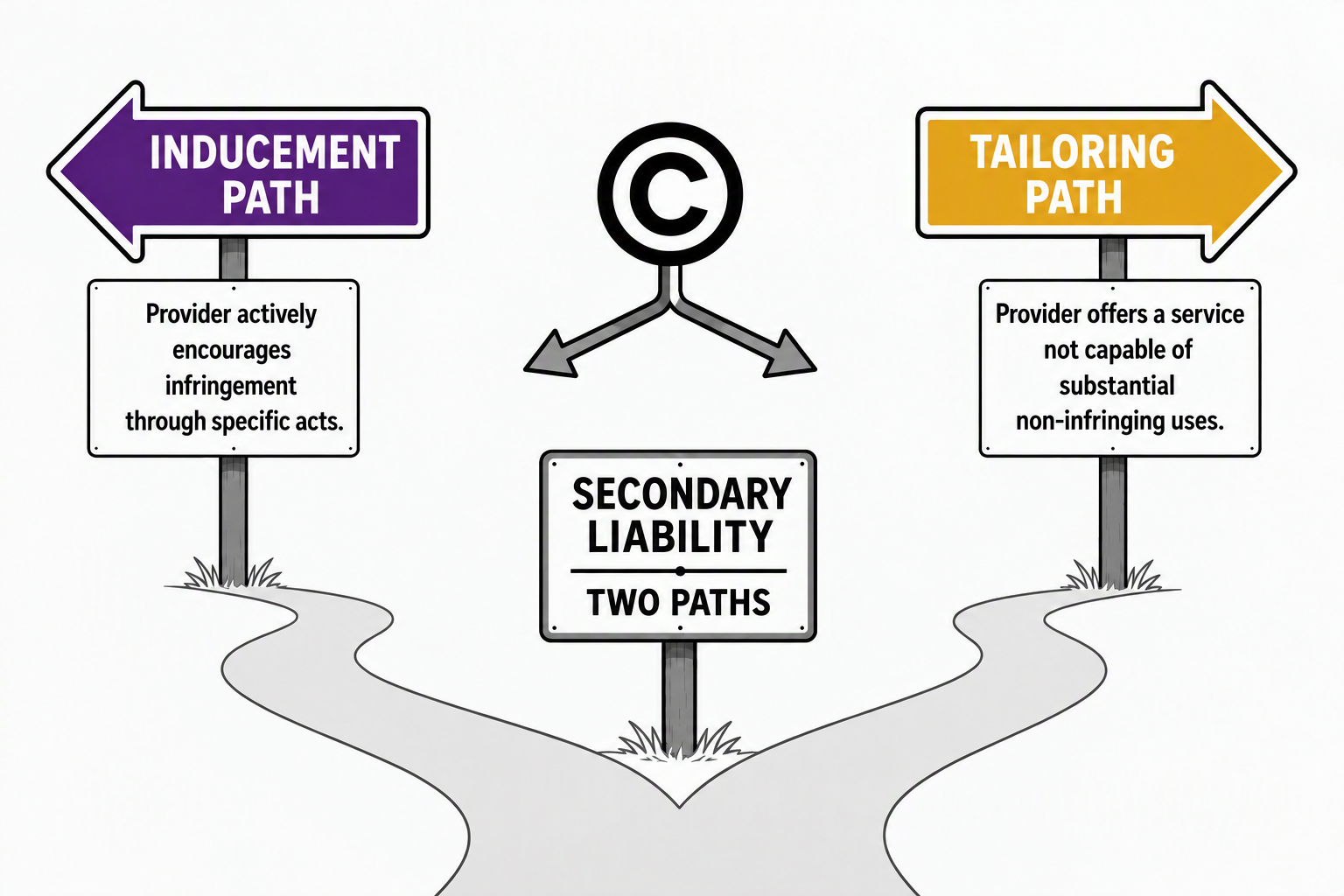
Cox doomed Weekend Warrior’s contributory infringement claim. There was no evidence that Amazon encouraged creators to upload infringing designs or otherwise promoted Merch on Demand as a tool for infringement. And Merch on Demand plainly has substantial legitimate uses, and Weekend Warrior could not reasonably contend otherwise. With no evidence that Amazon intended Merch on Demand to be used for infringement, the court granted Amazon summary judgment on the claim.
Vicarious Liability
Amazon did not fare as well on vicarious liability. To make out a claim for vicarious infringement, a plaintiff must show that the defendant (1) had the right and ability to supervise the infringing conduct, and (2) had an obvious and direct financial interest in the infringement.
The court found sufficient evidence of both. On control, Amazon did much more than provide a platform and hope for the best. It decides who may participate in Merch on Demand, reviews designs before they are listed, conducts ongoing audits for potentially infringing content, and can remove listings or suspend or terminate creator accounts. Most importantly, Amazon can stop the allegedly infringing activity itself. Unlike a search engine that can remove a link but cannot eliminate the infringing material from a third-party website, when Amazon removes a Merch on Demand listing, the product effectively disappears: the physical product does not even exist until someone orders it and Amazon manufactures it.
The financial-benefit prong was even easier. Amazon receives the customer’s payment for each product sold and pays the creator a royalty, retaining the balance. Thus, Amazon directly benefits when an allegedly infringing product sells.
Amazon countered that it actively polices infringement, so it can’t be said to have declined to stop it. The court acknowledged that Amazon takes some steps, but found that its reporting tools “leave much to be desired.” In the court’s view, Amazon’s response to Tim’s notices “could best be described as dismal." Despite “providing all the information that Amazon requested, Amazon’s automated process decided Tim Whelan’s contacts were ‘fraudulent,’ and Amazon sent any ensuing emails directly to the trash.” The court recognized that Amazon has a real fraud problem. Bad actors file bogus takedown notices to knock out competitors, and Amazon’s expert called the potential for abuse “significant.” But the court wasn’t willing to say, as a matter of law, that Amazon’s system adequately polices infringement. Reviewing reports at that volume “may be resource intensive,” the court said, “but that is the cost of operating a service where anyone can upload designs – system ripe for infringement.”
Amazon escaped contributory liability because there was no evidence it intended Merch on Demand to be used for infringement, but it still faces claims for vicarious liability because it could stop the infringement and profited from the sales. For platforms that exercise substantial control over user-generated products, Cox may have closed one door to secondary liability while leaving another open.
Weekend Warrior Clothing, LLC v. Amazon, No. 1:23-cv-752, 2026 WL 3072022 (S.D. Ohio Oct. 14, 2026)